The Giant Pacific Octopus’s Four-Year Lifespan
Remarkably Bright CreaturesThe Giant Pacific Octopus’s Four-Year Lifespan gives Marcellus McSquiddles’s story its hard boundary: a life measured not in an open-ended future but in 1,460 days, most of them spent in captivity. The number appears first as aquarium information and becomes personal when Marcellus reckons that he was brought there as a juvenile and expects to die in his tank. His return to the sea does not erase mortality; it makes the final days his own.
The stated limit and the captivity count
The four-year figure is presented as the average lifespan of a giant Pacific octopus, printed on the plaque beside Marcellus’s tank. Marcellus translates that general fact into a precise measure of his own life: four years, or 1,460 days. The plaque’s impersonal information thus becomes a private calendar. The tank is not merely where he lives; in his early understanding, it is where his allotted time will end.
Marcellus describes himself as having been brought to the aquarium while still a juvenile. At the point when he considers the sentence imposed by captivity, he allows at most 160 days before it is complete. That estimate makes the enclosure feel temporary only in the bleakest sense: its end seems likely to coincide with his death. His repeated captivity-day counts give the reader a second measure alongside the species’ lifespan, one that records not just how long he has lived but how much of that life has passed behind glass.
The numbers also make the countdown concrete without making it comforting. Four years is an average, not a promise of extra time, and Marcellus treats his own death as imminent rather than assuming that the full span will be available to him. The difference between a biological limit and a precise personal deadline remains important: the lifespan sets the frame, while Marcellus’s statements convey his expectation that his particular life is nearly over.
Seasons and the passing of days
The countdown is marked not only in days but in seasonal change. As daylight lengthens and darkness shortens, Marcellus recognizes that summer is approaching and identifies the summer solstice as the longest day of the year. He calls it his final summer solstice. A recurring feature of the natural year becomes a singular event for a creature who expects not to see another cycle. The season is both ordinary and terminal: the world continues its rotation, but his time within it is nearly spent.
Elsewhere, the narration places Marcellus at 1,329 days of captivity when he reflects on the acuity of his observations. He has used that long confinement to study the humans around him, noticing physical features, voices, gaits, and habits. The passage makes duration double-edged. Captivity has narrowed his world and brought him closer to death, yet the days have also accumulated into a practiced knowledge of the people he watches. Time is not simply lost; it has shaped what he can perceive and understand.
The book sets this compressed animal timescale beside the longer routines of human life. Tova Sullivan, the Sowell Bay Aquarium’s oldest employee, is seventy and works night after night, mopping floors, cleaning glass, and emptying bins. Her days are measured through work and habit, while Marcellus’s are counted against a lifespan with a stated four-year average. Tova is also sorting family possessions for a planned move to Charter Village, a transition that gives her own time a different texture: accumulated years are held in objects and decisions, while Marcellus faces a limit that cannot be postponed by arranging the future.
A final season beyond the tank
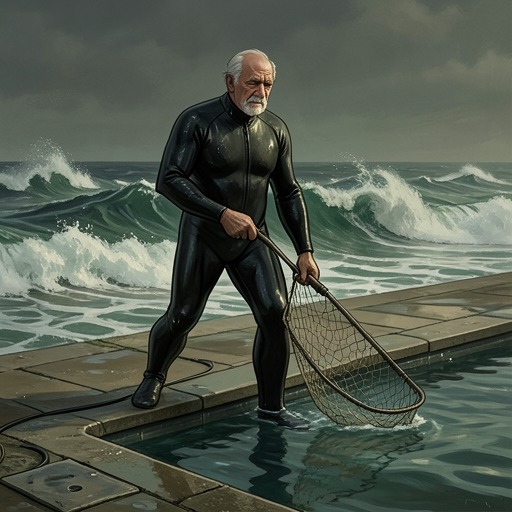
The lifespan’s most consequential change comes when Marcellus is released. By then, he is visibly frail, and Tova understands that he may have only weeks or days left. She brings him in a yellow bucket along the waterfront toward the jetty, a slow passage from the aquarium’s confinement toward open water. His release is not presented as a cure or an extension of his expected life. It changes the conditions under which his remaining time will be lived.
After reaching the sea, Marcellus says that his death is still imminent, but that he is not yet dead. He imagines having a day or two in which to experience the vastness and darkness of the ocean. He swims away from the rocks, descends into deep water where light does not reach, and returns to the place where, as a juvenile, he found a human key among objects left on the seafloor. There he lies with the long-disintegrated bones of Tova’s beloved son, Erik Sullivan. The return ties the end of Marcellus’s life to an earlier discovery and to Tova’s grief, without suggesting that the sea can restore what has been lost.
What the limit means
The four-year lifespan is more than a biological fact attached to an aquarium display. Because Marcellus knows the figure and counts his captivity, it organizes the story around a conflict between duration and freedom. His life cannot be made long, but the place in which it ends can change. The movement from tank to sea therefore matters precisely because it does not cancel the deadline: it offers a different final experience within the same finite span.
The contrast between the expected death inside the tank and Marcellus’s actual return to the depths gives the countdown its final reversal. For nearly four years, he believed that captivity would contain his entire life. Instead, he reaches the open sea again, aware that only a brief interval may remain. The story preserves both facts—the nearness of death and the reality of freedom—rather than allowing one to erase the other.